Breaking News: Quincy School Committee Approves Lunar New Year Holiday!

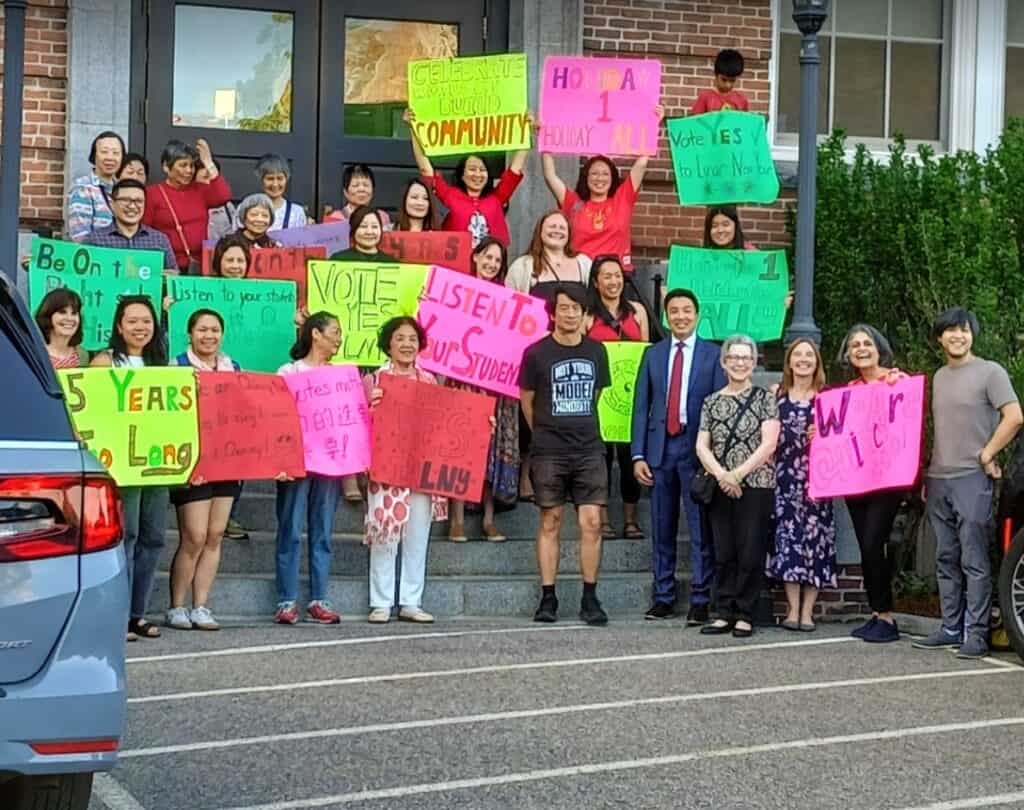
Supporters of Lunar New Year holiday rally before School Committee Meeting
Supporters of Lunar New Year holiday rally before Quincy School Committee meeting on May 20, 2026. Photo by Lisa C. Johnson.

It finally happened! Tonight the School Committee for Quincy Public Schools unanimously voted to make Lunar New Year a holiday for the students!

The push for the holiday started with students five years ago. And it finally paid off.

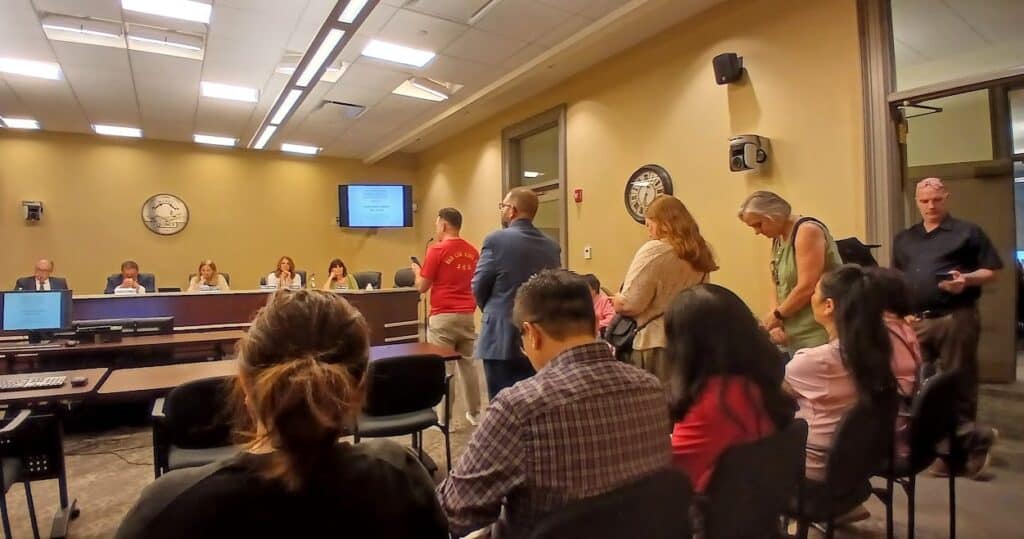
The Quincy community showed up again and spoke in favor of the holiday. From students to grandparents and all in between. There was an overflow room for all the people that attended.

Supporters of Lunar New Year holiday line up to speak at Quincy School Committee Meeting
Supporters of Lunar New Year holiday line up to speak at Quincy School Committee Meeting on May 20, 2026. Photo by Lisa C. Johnson.

One of the student advisors to the School Committee spoke about how he does not celebrate Lunar New Year, but he knows that it’s it important to his fellow students. He mentioned that so many students take the holiday off that nothing new is started by teachers that day, so they often end up with busy work.

He talked about the importance of students being able to spend time with their grandparents on Lunar New Year. Just like he cherishes the sixteen Christmases that he was able to spend with his grandparents. Especially since he recently lost grandparents.

After everyone spoke, the Committee went into an Executive Session to meet with counsel, so we all had to leave. After about a half an hour, we were called back in. New School Committee Member Tom Leung read a statement into the record about the long road to this vote. Then the voting began!

It all happened so quickly that I think we were all a bit stunned. Finally it passed! It makes me feel good that Quincy is on the right side of history. With this being our nation’s 250th birthday, it’s about time.

Quincy School Committee Meeting – Lunar New Year

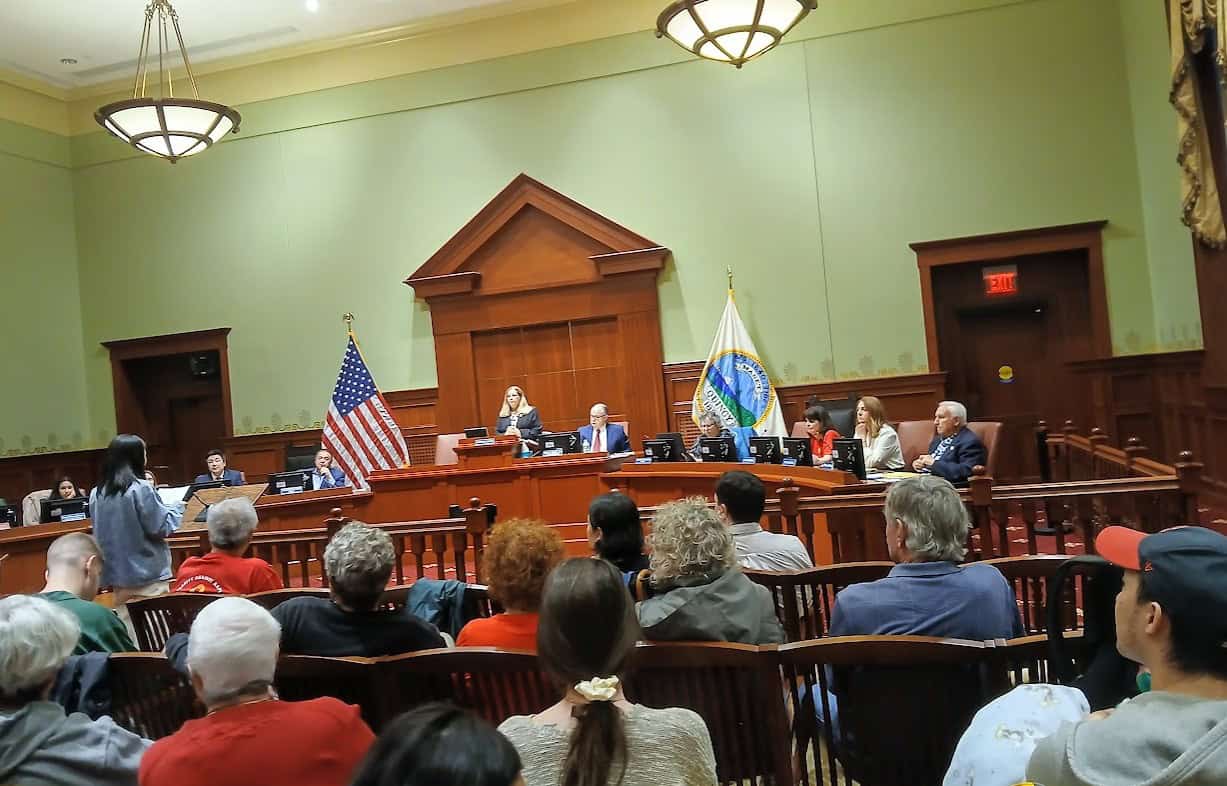
Quincy School Committee meeting
Quincy School Committee meeting on May 6, 2026. Photo by Lisa C. Johnson.

This past Wednesday evening, I attended my first ever school committee meeting. I don’t have children, so it’s not the type of thing that impacts me directly. But as a longtime resident of Quincy, I am interested in issues that impact Quincy at large. Especially when the issue relates to fairness, inclusiveness and respect. Several people told me about the meeting and urged me to go. So I was happy to attend.

Quincy Public Schools “recognize” Lunar New Year as a cultural holiday, but schools remain open. However, Good Friday is a holiday where schools are closed.

Quincy is approximately 30% Asian and the percentage of Asian students in Quincy Public Schools is close to 40%. In some schools, Asian students are the majority. For years, many Quincy residents have been trying to close the schools on Lunar New Year and have it truly recognized as a holiday.

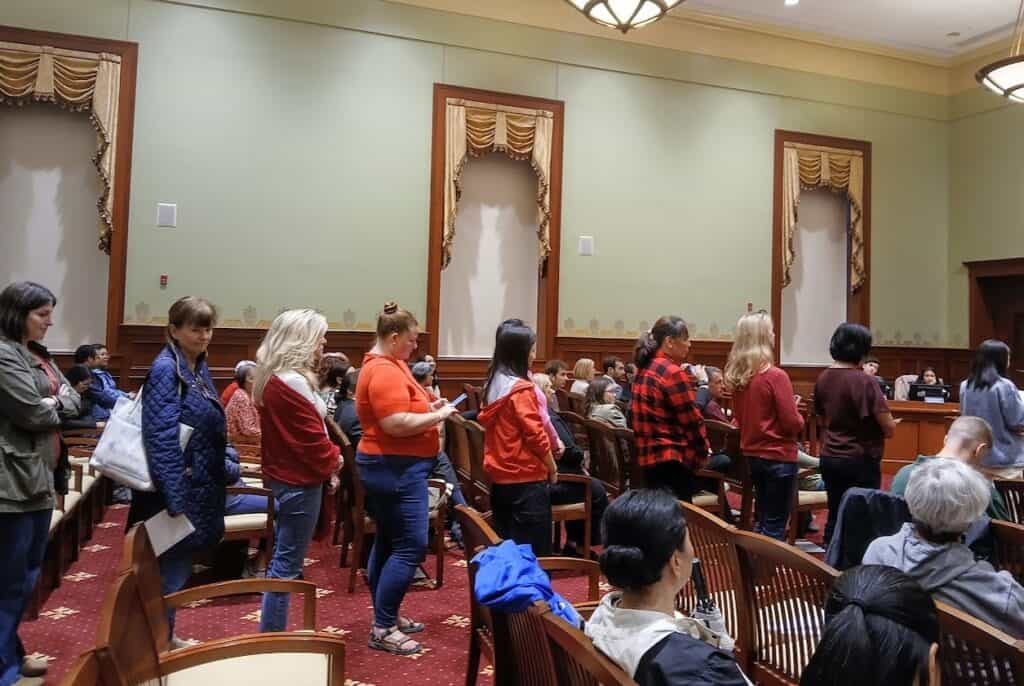
Quincy School Committee meeting
Quincy School Committee meeting on May 6, 2026. Quincy residents lined up to speak in favor of Lunar New Year becoming a holiday for Quincy Public Schools. Photo by Lisa C. Johnson.

At this point, I can’t understand the opposition to the holiday. It seems like disrespect at best. And at worst, it feels like blatant racism.

While this would be a school district holiday, it reminds me of the decades long fight to make Martin Luther King, Jr.’s birthday a federal holiday. There was so much resistance!

But Quincy residents are not discouraged. They are galvanized. People wrote letters. They showed up at this meeting and stood in line to speak.

Many spoke about how Lunar New Year is the most important holiday of the year to many different Asian groups. It’s not just Chinese New Year. Many added that for Asian kids, going to school on Lunar New Year would be like going to school on Christmas Day. It’s unimaginable.

Lunar New Year is a full day with extended families gathering — going to temple, eating special foods, wearing traditional garb, red envelopes, and the passing down of culture from older generations to the next.

Several grandmothers spoke about missing time spent with their grandchildren because they had to go to school. Parents take time off from work to celebrate with their families. So for the children to miss out is hurtful to families. And hurtful to the children themselves. How much time do most children have to spend with grandparents? That time is so limited. You can’t get it back.

It was not only adults speaking either. There were two children who spoke in favor of schools closing on Lunar New Year. A girl and a boy. I think the boy said that he was 11 years old.

He spoke calmly and came out of the gate running by talking about the Chinese Exclusion Act. He mentioned that this day, May 6th, was an important date because it was when the Act became law. And how he was so sad when he learned about it.

Then he spoke about how he is Chinese Vietnamese and feels excluded because his holiday is not truly seen. He has to choose between going to school or spending the holiday with his family and that it isn’t right. He received a standing ovation. The next generation is ready.

People spoke about children’s attendance record being impacted and that sometimes most kids in classrooms would not be there on the holiday. That impacts everyone to not have full class participation.

After everyone spoke, the committee decided to table the vote for two weeks because they needed input from legal counsel. The vote should take place on May 20th. I hope to be there.

Community, DNA, Kin & Black History

DNA description and genetic community

“Your ancestors are always your ancestors. But their communities may not be your communities.”

                                                                                              ~ Matt

The quote above is from an article called “To Be Good Kin” on the website Midnight Sun and it makes a lot of sense.

Just because our DNA says one thing, doesn’t mean that’s our community — regardless of the percentage. The article is an excerpt from the book, Becoming Kin: An Indigenous Call to Unforgetting the Past and Reimagining Our Future, by Patty Krawec, which will be released this September. The author is Anishinaabe and writes about how settler colonialism tried to change Indigenous ways of life and the idea of kinship.

Kin & Community

I feel like I sort of understand the big picture idea of kinship. But not so sure I understand the exact detailed meaning. There are many definitions for it.

Merriam-Webster says it’s a group of persons of common ancestry or clan; one’s relatives. According to Oxford, it’s our family and relations. Vocabulary.com says it’s a group of people related by blood or marriage. However, I would also add that it should include people related by adoption. But I don’t think these definitions cover everyone.

What about a neighbor who takes in someone who is unrelated and there is never a formal legal proceeding to make them family? What about close friends who are like family? We all have “aunts” and “uncles” who aren’t blood relatives, but they are part of our families. Are they kin? They’re definitely part of our communities.

Each of us has more than one community. But sometimes, because they are so intrinsic to our identities, we may not really think about it. We may take these different groups of people for granted. One group might center around our work or school. Another may revolve around our spiritual life. Another may revolve around a sport or hobby. One of the most central is based on blood relatives. Friends who enter our lives through one or more of these groups also play vital roles in our lives.

Maybe depending upon how close we get to certain individuals in these groups, any of them could be considered kin. Maybe all of them. I’m not really sure. What if you don’t spend holidays or other special occasions with your blood relatives, but with members of your church or your book club? What if you combine all of them?

The idea of kin and community is fascinating and worthy of much discussion. Thinking about the quote above made me think about my DNA results. They are all over the map, but heavily concentrated in West Africa. While I don’t know the names of the individuals, the blood in my veins is from my ancestors. The majority who hailed from Cameroon, Congo, Nigeria, Benin & Togo, Ivory Coast & Ghana.

Black History Month

I hadn’t planned on writing a Black History Month post. Often the celebration feels forced and fake. Like when conservative Republicans have the nerve to say they are celebrating it on Twitter at the same time they are doing everything possible to prevent Black people from voting.

Anyway…. The countries that my ancestors are from reveal a pattern showing the history of this country. A horrible and frightening trend by many states and localities seeks to prevent teaching American slavery and the history of Black people in this country.

My DNA connects me to three specific genetic communities: Early North Carolina African Americans (1700 -1800); Kentucky, Tennessee, Georgia, Alabama & Mississippi African Americans (1775 – 1950), Mid-Atlantic Coast African Americans (1750 – 1950). Where certain Africans were taken from and brought to in the United States is evident in my DNA now and in the DNA of all of us who descend from Africans enslaved in this country. No matter the attempts to erase what happened, it shows in the science.

Slavery severed generations of families and communities in countries all over Africa. It contributed to the growth of the African diaspora and the creation of African Americans. These ancestors’ communities may not be mine, but at least knowing the countries lets me be curious in a more specific way. And maybe I can learn more about these communities in the future.

If you’re interested in learning more about Black History, during the month of February, you can stream for free a three-part class: Black History, Black Freedom and Black Love on MasterClass.com.

Recently on Craving Boston: Power Café

*Updated 2/15/2020: Unfortunately Power Café has closed.*

Power Cafe

In case you haven’t seen it yet, I hope you’ll take a look at my most recent article on Craving Boston, where I interview Galit Schwartz. She opened Power Café, a new bakery in Watertown founded on good food and inclusion of those with developmental disabilities. Two things that are very important to me.

You may recall my fundraising for All Aboard The Arc! and my affiliation with the Brockton Area Arc, whose mission is “to work in partnership with, and for, the community to provide advocacy, information, and direct services for children and adults with intellectual and developmental disabilities, and their families.”

Speaking with Schwartz and learning how she became involved with the disability community and creating a cafe was so inspiring. I hope you’ll be inspired too!

+++
Screenshot: Craving Boston