
The Foods: Jollof and Kimchi
Have you ever eaten kimchi? It’s known around the world as a spicy fermented Korean dish, usually made with cabbage. Ever tasted Jollof rice? It’s a West African rice dish made with spices and tomatoes. The online “Jollof wars” are hilarious and feature people from different West African countries, like Nigeria, Ghana, Senegal and Cameroon, debating and joking that their country does it best.
While I’m not sure if UNESCO carries any weight in these wars, they do examine cultural heritage. And they determined that the winner of the Jollof Wars is Senegal.
Knowing about the origins of Jollof rice and kimchi, usually you would not put the two together. They are distinctly referring to a West African food and a Korean food. However, if you were to suddenly see the two food dishes mentioned together, it could be a shorthand way of referring to West African and Korean.
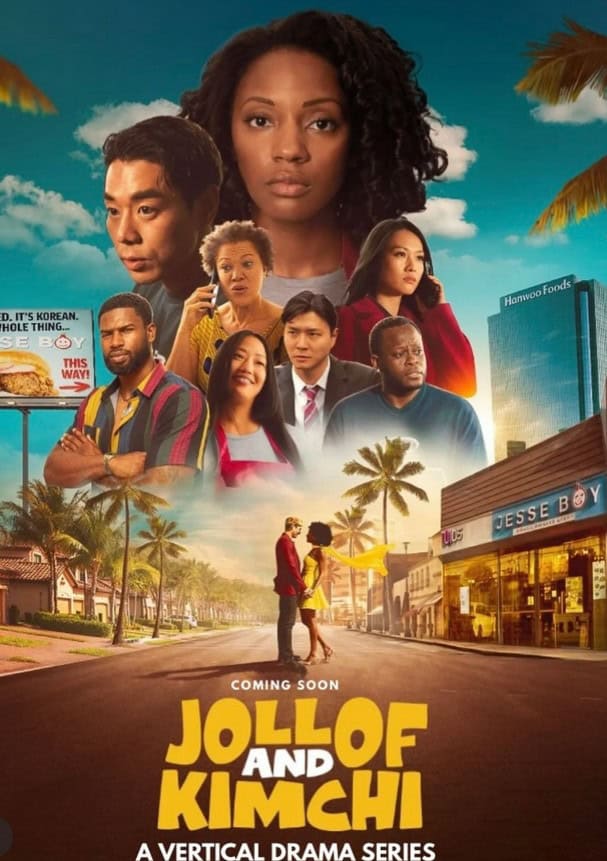
So when I first learned about a new vertical series on Instagram called Jollof and Kimchi, I thought it seemed really interesting. It’s described on the Instagram page as, “A first generation K-Drama × West African vertical drama.” Even though, as far as I know, it’s only streaming on different social media platforms, it has an IMDb page and listing as a TV series with the description below.
After getting thrown out by her cheating husband, Kelli Ngum seeks refuge in a Korean fried chicken shop run by Jungmin, a quiet restaurant owner hiding a dangerous secret: he’s the estranged heir to a powerful and corrupt Korean conglomerate. What begins as a job opportunity becomes a forbidden romance that ignites a cross-cultural showdown.
For the past several weeks, I’ve been watching. I love a good K-drama. Especially in the dumpster fire of a world that we’re living in. The escape is magnificent. Even if each episode is only about a minute or two.
A Real Life Korean Drama
Before the Jollof and Kimchi series began, starting this past December, I was also following Candice Marie on Instagram. She is a Black American woman living in South Korea. She started telling her audience about a cafe that she visited where there was a very nice and handsome barista who would chat her up. Turns out he was the owner of the cafe. Anyone who watches K-dramas immediately thinks, “Hmmm. A chaebol heir?“
They bonded over coffee, music, and hilarity ensued. She captivated her followers with “storytime” giving weekly updates about their conversations. It was like a real life K-drama and she framed it that way as well. With videos titled “POV: Your type is the Korean barista who don’t speak English” and “POV: Your love life is a KDrama series” and other similar titles.
From her posts, Candice speaks enough Korean to communicate, but sometimes there seemed to be problems with translation. Anyway, there is a lot more to their story, but I won’t go into it.
I mention this “series” because from this past winter to this spring, there was a palpable intrigue on social media with the romance between a Black American woman and a Korean man. Tens of thousands of mostly Black women, including me, were fascinated and caught up with her story. On social media you can also find many other similar interracial couples.
The algorithm got it right when they served up the Jollof and Kimchi series in my Instagram feed this month. And presumably also the feeds of the thousands of others who were already onboard for a Black woman and Korean man romance involving food.
But what happens when a K-drama inches too close to real life? The way that it’s looking now, the K-drama turns into a legal drama.
The Couple
Searches of “jollof and kimchee, ” “kimchi and jollof,” and “jollof with kimchi” bring up several results. There was even a delicious looking picture of Ghanaian Jollof rice with kimchi on reddit!
But many of the top results include this series and a real life couple, James and Wuraola, with the handle @kimchixjollof (Kimchi & Jollof) on various social media platforms. He is a Korean chef and she is a Nigerian creative. A recent Instagram post of theirs states in part, the following.
“Over the past 6 years, we have poured our hearts into building Kimchi & Jollof, a brand under which we provide content rooted in love, culture, food, storytelling, and our experience navigating life together as a Korean and Nigerian couple. … Recently, we became aware of a 34-part series titled Jollof and Kimchi that we believe shares notable similarities to the name, cultural framing, and identity closely associated with the brand and the community we have intentionally built over the years. As creators, we understand that inspiration exists online, but we never expected a project to adopt a confusingly similar to ours such that viewers are likely to believe, mistakenly, that the project is associated, sponsored, affiliated, or approved by Kimchi & Jollof. It is not. We’ve seen many questions asking whether we have considered legal action or attempted to resolve this privately before speaking publicly. The answer is yes.“
When I saw the video, I was quite surprised that she describes the series as a “West African girl falling in love with a Korean chef.” In the series, he is not a chef. As the IMDb page describes him, “he’s the estranged heir to a powerful and corrupt Korean conglomerate.” Because Jungmin left his family business in Seoul, he is now running a fried chicken shop. As he told his father, “I’ll build something that doesn’t require me to lose myself.“
When Kelli, who is Cameroonian American, is thrown out of her house by her husband, she needs to find work, so Jungmin hires her. She literally almost falls down. So in classic K-drama fashion, of course, he catches her. We soon find out that she went to Wharton, and he did too, but in different classes. She used to work for Google, but left years ago. Apparently to be a stay at home wife.
At least to me, this drama is clearly a work of fiction and does not appear to be based on the lives of any real people. There are plenty of Black and Asian interracial couples in real life. Also, there are other instances of the words Jollof and Kimchi being used together. Outside of this series and the couple.
Sam Okyere
Azäh Awasum plays Kelli in the series Jollof and Kimchi and is also a co-creator. She recently issued a video statement regarding the dispute with the couple and the origins of the term Jollof and Kimchi. She shows an Instagram post by Sam Okyere from April 21, 2017, wearing a T-shirt with the words, “Jollof With Kimchi.“
Awasum states that Okyere created the campaign “Jollof With Kimchi” and that this movement went across the entire world showing what could happen if two different cultures worked together. Interracial couples, groups, dancers and artists started using this as a descriptive term showing AfroKorean fusion. She also states that back in 2021, her co-creator used this term in a skit that he wrote. That skit went viral and she states that this skit is the basis for the current series. She says that they had no knowledge of the couple.
Independently, I searched for this post on Instagram and found it as well. Sam Okyere is a Ghanaian television personality living in South Korea. Further, I found an Instagram post dated October 7, 2016, showing him wearing a T-shirt that says, “Jollof with kimchi – I don’t think far[.]” On the post he writes, “It’s official!!!Jollof with kimchi!!!! I don’t think far!!! I endorse this.”
On March 4, 2019, he has another Instagram post, showing him, an Asian woman and another Black man all wearing T-shirts that say, “Jollof with Kimchi.” The English portion of the text reads, “The best war after Star Wars. “Jollof Wars”.. Question: Which country has the best Jollof? . Please note. All jollofs matter. Best caption wins a free Jollof with kimchi shirt.”
Trademark Dispute
Full disclosure, I am a licensed attorney. I have no relationship with any of the aforementioned parties and this is not legal advice.
I am merely a fan of the series giving my thoughts on the matter. I am not an intellectual property expert. But I have written about trademarks for LegalZoom and worked on cases where trademarks were an issue.
It appears that both the couple and the series have retained counsel, but I have not found any pending litigation by either party against the other.
The United States Patent And Trademark Office (USPTO) does have a pending trademark application for a Service Mark [US Serial Number: 99747891] for “Jollof and Kimchi” filed on April 7, 2026, by Jukbox Productions, LLC, for “Film and video film production; Film and video tape film production; Film production; Entertainment services in the nature of organizing social entertainment events [.]”
The couple has a pending trademark application with the USPTO as well, filed on April 10, 2026, by Kimchi & Jollof LLC, for a Service Mark [US Serial Number: 99756317] for “KIMCHI & JOLLOF” for “Entertainment services in the nature of development, creation, production and post-production services of multimedia entertainment content; Providing online non-downloadable videos in the field of lifestyle, travel, beauty, fashion, food, cooking, culture and relationships.”
Both applications were accepted by the USPTO, but have not yet been assigned to an examiner.
Eliminating or at least reducing consumer confusion is the reason for trademarks. The USPTO describes a trademark as follows.
A trademark can be any word, phrase, symbol, design, or a combination of these things that identifies your goods or services. It’s how customers recognize you in the marketplace and distinguish you from your competitors. The word “trademark” can refer to both trademarks and service marks. A trademark is used for goods, while a service mark is used for services. A trademark:
- Identifies the source of your goods or services.
- Provides legal protection for your brand.
- Helps you guard against counterfeiting and fraud.
A common misconception is that having a trademark means you legally own a particular word or phrase and can prevent others from using it. However, you don’t have rights to the word or phrase in general, only to how that word or phrase is used with your specific goods or services.
Trademarks that are not unique are weak and harder to federally register. Especially when they are descriptive or generic.
Interestingly enough, in 2022, the phrase “Kimchee Girl” was trademarked. In 2024, an application to trademark just the word “Kimchee” was filed. In 2025, the case was abandoned.
This post was updated from when I first wrote it with newly found information. Now I’m feeling a bit more ambivalent.
Sam Okyere was using his similar phrase years before the couple — it appears from 2016 to 2019. It’s not clear if he is still using it, but he was selling T-shirts. Also, he was using the phrase in Korea, but it’s possible that he made some sales outside of Korea as well. Putting the phrase into the international stream of commerce.
How will things turn out in the end? I’m not sure. There is a lot that we don’t know. If any of the parties decide to sue, then much could be learned during the discovery process of litigation. However, that takes a lot of time and money. I’m sure that the parties will try and settle things behind the scenes.
We will have to wait and see. I just want to keep watching my show!
